
About us
Asia Engineering prides itself as one of the leaders in fire fighting company in Bangladesh about industrial, residential and commercial safety equipments. We provide the latest technology and equipnent allowing us to give our customers the best service possible. We also do a follow up on all clients to ensure that all equipment supplied is efficiently running and serviced on time. We have grown out of the need on ensuring safety and professional guidence to the public for safer and proper uses of all the fire and industrial, residential and commercial safety equipment.
ENGR. MD. MIZANUR RAHMAN
B.Sc. in Civil Engineering, MEAB, MIAENG
Certified in (NFPA) 20, FM Global, F.S.M.C (ITCILO)
PGD in Fire Science & Technology, BFSCD, F.S.I
CEO
CEO’S Message
We are very proud and pleased to introduce ASIA Engineering,Total Fire Safety Solution Company.
ASIA ENGINEERING has established itself as a market leader in Designing, Manufacturing, Marketing, Electrical & Fire Safety items. ASIA ENGINEERING is one of the most reliable Fire Protection Consultancy firm in the country for industrial, commercial and residential building detailed safety assesments, all kinds of Fire Fighting Design Drawing, all kinds of fire fighting equipments supplier, installer and supervision.
ASIA ENGINEERING is committed to their clients for the quality of all its products. We are already serving a large number of clients with full satisfaction.
Director’s Message
Asia Engineering provides comprehensive fire protection service to safeguard buildings, assets and lives from fire hazard. We offer solutions such as design, installation and maintanance of fire detection systems, sprinkler systems, fire alarms and fire supperssion systems like FM-200. Asia Engineering also condact risk assesments, ensuring compliance with local fire safety regulations and building codes. Asia Engineering provides fire extinguishers, fire rated door and fire proofing materials for enhanced protection. We often offer fire safety training for employees, teaching proper evacaution procedures and the use of fire fighting equipments.
Md. Delwar Hossain
Director
We’re great at
CONSULTANCY
1. Fire Hydrant & Stand Pipe System
2. Fire Detection & Alarm System
3. Fire Supperssion/Novac System (FM-200)
4. Single Line Diagram (S.L.D.)
5. Lighting Protection System (L.P.S)
6. Fire Safety Plan (Approval from BFSCD)
7. Details Engineering Assesments (DEA)
8. Industrial Design & Drawing
SERVICE, SUPPLY AND INSTALLATION
1. Fire Hydrant & Stand Pipe System
2. Fire Detection & Alarm System
3. Sprinkler System
4. P.A. System
5. Fire Rated Door (UL & Non UL)
6. Lighting Protection System (L.P.S)
7. Fire Supperssion/Novac System (FM-200)
8. Fire Curtain (UL Certified)
9. Fire Collar (UL Certified)
10. Gypsum Work (UL Certified)
11. Expansion Joint
12. Fire Door Accessories (UL & Non UL)
13. CCTV Syatem Sales & Installation
A few things we’re great at
Fire Hydrant & Standpipe System
Fire hydrant and standpipe systems are essential components of fire protection in buildings:
Fire Hydrant System:
Fire hydrants are outdoor connection points to a water supply, enabling firefighters to access water quickly during emergencies.
Hydrants are connected to underground pipes, facilitating the distribution of water throughout the building or surrounding area.
Equipped with valves and fittings, hydrants allow for the connection of hoses to fight fires effectively.
Standpipe System:
Standpipes are vertical pipes installed within a building, equipped with hose connections on different floors.
Class I standpipes are dedicated for use by the fire department, while Class II standpipes are accessible to building occupants and the fire department.
Standpipes provide a means for firefighters to access water at various points within the building, aiding in fire suppression efforts.
Both fire hydrant and standpipe systems are vital for ensuring rapid access to water during fire emergencies, enabling firefighters to effectively combat fires and minimize damage to property and lives. Regular maintenance and testing are essential to ensure the reliability and functionality of these systems.
Fire Detection & Alarm System
A Fire Detection and Alarm System is a crucial component of fire safety in buildings, designed to detect the presence of fire and alert occupants to the emergency. Key aspects of a fire detection and alarm system include:
Detection Devices: The system incorporates various types of detectors, such as smoke detectors, heat detectors, flame detectors, and gas detectors, to sense the signs of fire.
Alerting Devices: When a fire is detected, the system activates audible and visual alarm devices, such as sirens, horns, strobe lights, and annunciator panels, to alert occupants and prompt evacuation.
Control Panel: A central control panel receives signals from detectors and alarm devices, processes the information, and initiates appropriate responses, such as activating alarms and communicating with emergency services.
Monitoring Services: Some fire detection and alarm systems are connected to monitoring services that can notify emergency responders automatically when an alarm is triggered, enhancing the speed of response.
Integration: Fire detection and alarm systems may be integrated with other building systems, such as HVAC (heating, ventilation, and air conditioning) and access control, to improve overall safety and response capabilities.
Testing and Maintenance: Regular testing and maintenance of the system are essential to ensure its reliability and functionality in case of a fire emergency. This includes inspecting detectors, testing alarm devices, and verifying communication pathways.
Overall, a fire detection and alarm system plays a critical role in fire safety by providing early detection of fires, prompt notification to occupants, and coordination with emergency responders, thereby minimizing damage, injuries, and loss of life in the event of a fire.
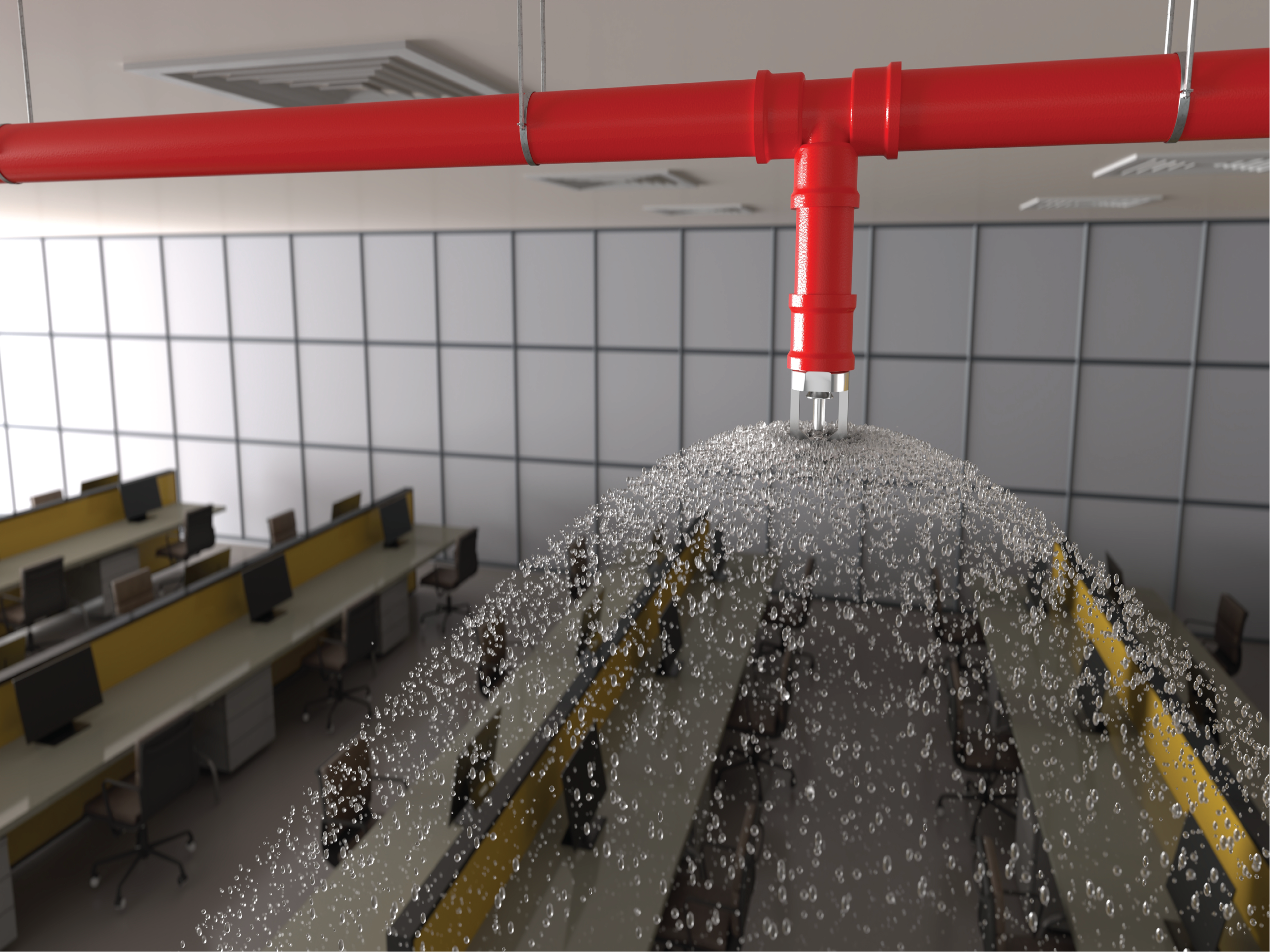
Sprinkler System
A sprinkler system is a vital component of fire protection in buildings, designed to automatically detect and suppress fires in their early stages. Key aspects of a sprinkler system include:
Detection Mechanism: Sprinkler systems are equipped with heat-sensitive elements that activate individual sprinkler heads when temperatures rise to a certain threshold, typically indicating the presence of a fire.
Water Supply: Sprinkler systems are connected to a reliable water supply, such as municipal water mains or dedicated water tanks, ensuring a continuous flow of water for firefighting purposes.
Distribution System: Sprinkler pipes are strategically installed throughout the building, with sprinkler heads positioned to provide comprehensive coverage. Upon activation, water is distributed evenly over the affected area to suppress the fire.
Types of Sprinkler Systems: There are various types of sprinkler systems, including wet pipe systems, dry pipe systems, pre-action systems, and deluge systems. Each type is suited to different environments and fire risks.
Our Valuable Clients
Brands
Which are colaboration with us
AMS Design & Consultancy
A sister concern of Asia Engineering
Click Here
Contact us
+880 1728-323766
+880 1967-480550
Send an email
Genova Tower : House #1(3rd Floor) Road # 4
Block # A, Section #11, Mirpur, Dhaka 1216.